Why 6G can't be another network replacement: A live discussion
September 24, 2026
"If you talk to a CTO about 6G, it doesn't matter which operator, they are scared. Because this means higher CapEx."
Every generation from 3G to 5G followed the same playbook: build a new network, absorb the cost and wait for customers to arrive. Years after the launch of 5G, most markets are still evolving toward it and sustained ROI remains challenging. As the industry starts defining 6G, the architecture decisions made in the near term will determine whether that cycle repeats.
On the latest episode of Zero-Touch Live, Vivek Chadha, Chief Growth & Marketing Officer at Rakuten Symphony, spoke with Enrique Blanco, Strategic Advisor to Rakuten Symphony and former Global CTIO at Telefónica, about what a modular, non-disruptive path to 6G requires.
📺 Watch the replay now below.
Who controls the next evolution
Enrique argued that the real 6G question is about the architecture approach. Key takeaways from the conversation include:
AI placement as the defining architecture choice. Embedding AI inside the radio, whether in existing units or new GPU-based radio units, delivers efficiency gains but locks in the architecture and shrinks the pool of industry players. Opening the radio and running AI outside it lets operators decide which providers, services and pace of evolution fit their customers best.
Open RAN performance parity as the first hurdle. Enrique acknowledged that radios with embedded AI outperform other approaches today. The industry needs to remove every doubt about Open RAN performance, power savings and quality, and he expects that to happen soon.
Interoperable OSS as the foundation. Enrique described OSS as essential as food and water. If the OSS suite is not interoperable, lock-in extends beyond the radio to every process that depends on it, and efficiency and performance end up out of the operator’s hands.
A measured on-ramp for brownfield operators. Instead of swapping everything at once, operators can move a share of base stations, 10% by Enrique's estimate, to open RAN managed by interoperable OSS. That proves the alternative, builds volume that brings costs down, and puts operators in a stronger position before 6G arrives.
Fiber and Wi-Fi as precedents. At Telefónica, requiring OLT and ONT interoperability regardless of vendor made it possible to build Wi-Fi services on an open ecosystem. Enrique also pointed to the ISDN era as a warning, when operators held tightly to closed protocols and ended up as pipes while others captured the services.
6G is coming and now is the time for operators to decide whether they build the technology that shapes it or simply buy it.
Every operator running agentic AI in production eventually faces the same question: is the token spend worth it? Most of that conversation stops at the cost of a single API call, when the more useful question is whether the agent made a good decision. In other words, did it earn its budget or quietly burn it?
Airline credit card partnerships now generate more profit than the flights themselves, in some cases several times over. Every major U.S. carrier runs a co-branded credit card program built on similar swipe-fee mechanics. Why isn’t telecom capturing the same returns?
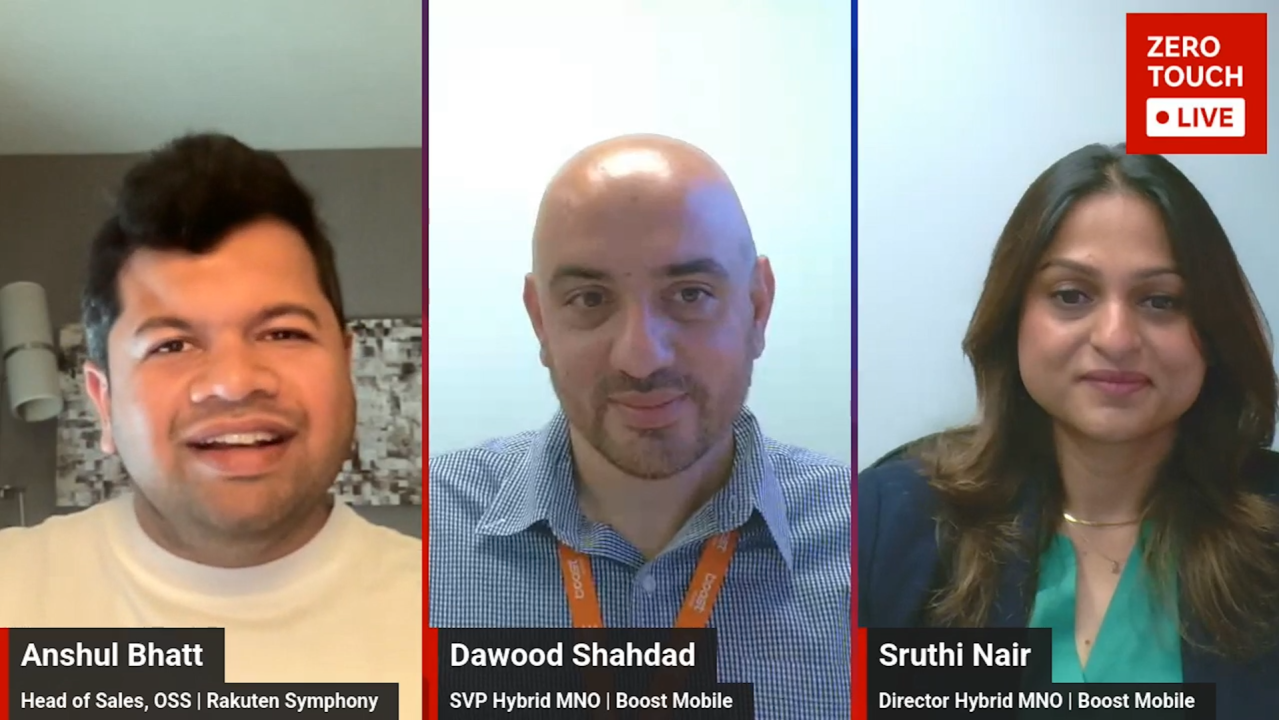
On this week's Zero-Touch Live, Rakuten Symphony's Anshul Bhatt speaks with Boost Mobile's Dawood Shahdad, SVP of Hybrid MNO Network, and Sruthi Nair, Director of Voice Core Engineering, about building one of the few operator networks running fully cloud-native on public cloud.
On this week's Zero-Touch Live, Rakuten Symphony’s Sachin Mahajan spoke with Mauricio Gonzalez Nappa, head of the telecom vertical at LATAM system integrator Isbel, which supports tier 1, tier 2 and tier 3 operator OSS, BSS and RAN deployments. They dove into what is happening on the ground as operators across the region pursue autonomous network ambitions, explore AI use cases to offset low ARPU and reassess the role of Open RAN.